Tuesday, April 29, 2008

Black Health Update - Diabetes & Amputations

A problematic symptom of having Diabetes or "sugar" is poor circulation, especially in the feet and legs (lower extremities) and poor healing of any sores and wounds. It is so important for people with diabetes to take really good care of their feet and to be careful. What happens is the the arteries aren't getting enough fresh or oxygenated blood to the lower parts of the body. Without this fresh blood, the body has a hard time getting all of the energy it needs to keep the muscles working in top condition. Combine poor circulation with poor movement, being over weight, and poor nutrition and it can inevitably lead to ulcers or festering sores in the lower extremities. If patients or their caretakers don't take them to the doctor soon enough it can lead to an amputation, often of a leg or foot.

Health researchers at Northwestern University, in Chicago have summarized a 20 year of study of diabetes patients in the Chicago area and found that black patients, primarily from the south and west sides are more likely to have a limb amputated. They found that African Americans have 5 times higher amputation rate than whites.

“Amputations are the canary in the coal mine for quality of care," said Joe Feinglass, lead author and research professor of medicine at the Feinberg School. “Many amputations are preventable. This means the primary care for minority people may not be very good. "
The high amputation rate for minorities in Chicago likely reflects other racial disparities in healthcare, Feinglass said. "Diabetes is a condition that is highly susceptible to quality of care. Amputation rates give you a basic idea of how the system is performing."

Read the entire article on ScienceBlog.

Stay Healthy. Stay Informed

Monday, April 28, 2008

The Science of the Sewer Study in Poor Black Neighborhoods

In response to the dialogue about this case, I have added some links that are a follow-up. Specifically, I want to address the science or scientific processes involved in this type of research. Here is the SOIL COMPOST STUDY TO REDUCE LEAD HAZARD FACT SHEET.

Here is the abstract or summary of the research experiment. The study was published in the peer-reviewed journal Science of the Total Environment. The journal is an international medium for publication of original research on the environment with emphasis on changes caused by human activities. It is concerned with changes in the natural levels and distribution of chemical elements and their compounds that may affect the well-being of the living world, or represent a threat to human health. Papers in applied environmental chemistry and environmental health sciences are particularly encouraged. This study falls well within the purview of this publication.

I do understand the environmental justice concerns of this research specifically with this research group, as noted by Francis Holland. I'm not dismissing his or others concerns. However, I think it is important that those who are most vocal about this issue demonstrate a basic comprehension of how this type of research is conducted and what this study found.

Let me break a few more things down.
In addition to Institutional Review Boards (see note in previous post), the peer-review process is another stop-gap for making sure appropriate procedures and ethical measures are followed in research. Research that is believed to be problematic is investigated and not permitted to be published. There are also number of professional reprimands for researchers are proven to be unethical or inappropriate when researching or reporting results.

The Abstract - rewritten
High lead concentrations in urban industrial areas are a big problem and can cause many health problems in people, but there is no one program to get rid of lead in soils, unless it is a big nasty spill from a company or factory. So there are many people who are exposed to lead in soil, but there is no feasible and affordable solution at hand. The researchers selected lawns in contaminated neighborhoods where the ground contained a fairly high concentration of lead which can get into the human and animal body systems. They used a commercially comparable compost, organic material from animals, that contained a fairly high concentration of iron and phosphate, and spread it over the lawns. Iron and phosphate can grab the lead in the soil and keep it from getting into the body system of people and animals. Iron and phosphate are also great fertilizers to improve the health and appearance of lawns.

The lawns were tilled, or dug up, and the compost was applied. They sampled the soil in the lawn several times to compare the levels of lead in the soil in various locations in the yard (near to the home vs farther away from the home) and many times over the course of the year. They compared the level of lead before the compost was applied and many times after the application.
At the end of the experiment, the lead concentration that can get into the body was much lower. The lower concentration of lead was more notable at areas closer to the home, where the risk of picking up lead was higher. At the more distant parts of the lawn, the treatment didn't lower the lead concentrations much, but there was always a lower concentration of risky lead in those parts of the yard. Plus, the lawns were healthier and more attractive at the end of the study. This research met its objective of finding a possible and feasible way of reducing lead in soil without having to dig up the whole yard and discard of the contaminated dirt in some undetermined place. This research is particularly important because it may provide an affordable solution to reducing lead poisoning risk in children.

Sunday, April 27, 2008

Sewer Study in Poor Black Neighborhoods - Good Science or Bad Policy?

Recently, some media outlets have cried a possible foul against the scientific research community concerning a study that fertilized lawns with human and industrial waste as possible remediation to lead poisoning. NPR News & Notes featured a piece about Scientists Under Fire for Sewage Sludge Study. Francis Holland ranted about it too on American Journal of Color Arousal. Study participants were all Black and lived in poor urban neighborhoods. Since this research is 'government funded' some are asking whether these participants were intentionally targeted and if the government is 'deliberately experimenting on vulnerable citizens'.

I realize that the black community is still untrusting of scientists and science research. And this issue has several groups like the NAACP up in arms claiming Tuskegee type issues. What is the main problem? That the recent research was done in those neighborhoods or that the research was done and people were harmed? If people were harmed AND they were not fully alerted to the dangers (I doubt that) AND they were not treated AND the incident was swept under the rug, then there is a point and the anger is justified. But according to the press stories none of these scenarios seem to be the case.

It seems the matter of research can’t be addressed objectively among the Black community because of the sensitivity regarding the Tuskegee Experiment. The Tuskegee Experiment was a sad page in history, but let's keep things in perspective. 1. Monitoring the unchecked effects of syphilis in blacks was a meaningful experiment - at that time. Back then, Syphilis was unchecked in everybody and because of racist beliefs, many people really believed that similar treatment in blacks as whites would have been a waste. As sad it is sounds, the doctors wanted to prove (not just provide anecdotal evidence) that Syphilis harms black people just as bad as Europeans. 2. What made the Tuskegee Experiment egregious was the fact that a cure had been found and they did NOT Inform the participants.

Since that case, the laws and ethics of clinical research have improved dramatically. Remember the finding that hormone therapy might be harmful to menopausal women? They pulled that treatment and halted that study. That's how research works now. Also, Institutional Review Boards (IRB) are VERY stringent and serious about critiquing ALL research before ANY experiment is done. They make sure everything is proper and safe and legal. They follow strict federal and state and professional research organizations’ procedures and ethics guidelines when conducting ANY research with living subjects, especially human. They err on the side of safety and caution. These Boards are not comprised of a group of like mined scientists who co-sign each other’s research. These boards consists of scientists, a doctor or veterinarian, lay persons from the larger community (such as clergy or politicians or teachers or community activist). And you best be sure the university administrators have lawyers look over things for liability as well.This case is a perfect example of a sensationalized story that was presented to speak to people’s fears and ignorance about science or research processes. I understand the sensitivity we have that poor, marginalized people may be being taken advantaged of in research studies. But that fear and the campaign against research is harmful.

This is a matter alerts me of the crucial need to increase the public’s awareness of science and research. The need to increase scientific literacy among people is not just limited to the marginalized and under-educated, specifically black people. I keep discovering that even presumably well-educated black people are still prone to get keyed up emotionally and are largely ignorant about science and how it proceeds.

Which leads me to address one more issue - Government funded research does NOT mean government directed research. Scientists develop hypotheses from direct observations. Hypotheses aren't handed down to scientists. This research was undertaken by a team of academic researchers. This was an idea that they developed, perhaps born of real-life issues they were encountering - lead poisoning of nearby residents (who happen to be poor and black). The researchers secured funding to undertake this research - they asked for the money, the government was not trolling around for researchers willing to make guinea pigs out of people.

Saturday, April 26, 2008

Human Origins in Africa - Weekly Science update

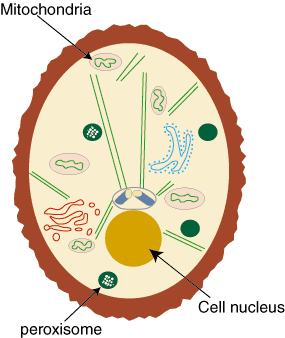
Palentologists and Population Geneticists have discovered and confirmed that our human ancestors originated on the dark continent. "A team of Genographic researchers and their collaborators have published the most extensive survey to date of African mitochondrial DNA (mtDNA). " The genetic material of the mitochondria, or powerhouse of the cell, is high conserved and has a very low mutation rate compared to nuclear or regular DNA. When sperm and egg unite, they each bring their fair share of nuclear DNA - 23 chromosomes. 22 Somatic or body chromosomes and 1 set of sex chromosomes to determine the gender of the baby. The chromosomes are the packages of ALL of your genes. Both the egg and sperm are single cells, but the egg, which is a bit larger than the sperm, also houses other cell organelles, including the mighty, mighty, mitochondria. So if you did a cheek swab, a la Maury Povich style, your mitochondrial DNA is exactly your mom's so on down the line.

"Mitochondrial DNA, inherited down the maternal line, was used to discover the age of the famous 'mitochondrial Eve' in 1987. This work has since been extended to show unequivocally that the most recent common female ancestor of everyone alive today was an African woman who lived in the past 200,000 years. Paleontology provides corroborating evidence that our species originated on this continent approximately 200,000 years ago."

So this backward game of chasing down the mtDNA has to deadline somewhere - that's to mitochondrial Eve. But the researchers found that there are 2 dead ends. Both deadline on the African continent, but separated geographically - eastern and southern Africa - and over many tens of thousands of years.

Check out the full article on ScienceBlog: Humanity nearly split in two, study finds

Tuesday, April 22, 2008

Black Health Update - Heart Disease.

I couldn't have said it better myself, so I'm linking the original post - Racial differences & heart attacks. But here are some key points.

  • About 40 percent of African-Americans have a genetic variant that can protect them after heart failure and prolong their lives, according to research conducted at Washington University School of Medicine in St. Louis and collaborating institutions.
  • The researchers...found that 41 percent of African-Americans have a variant GRK5 gene that more effectively suppresses the action of adrenaline than the more common version of the gene. People with the variant gene could be said to have a natural beta blocker, Dorn says. The variant is extremely rare in Caucasians, accounting for its predominant effects in African-Americans.
  • Razib goes on further to explain the importance of this research and why working with sub-populations (or different 'racial') groups is important to understanding not only effective medical treatments but evolutionary processes as well.

Keep learning.

Monday, April 21, 2008

Save money on gas


Two ways to go green without the extreme costs of hybrid technology.
The Set back - if you're a big guy - like my dad - these are not for you. What a shame, because these cars are affordable and the fuel efficiency and carbon footprint is much smaller than typical American Cars.
Happy Earth Day!!
Go Green!

Wednesday, April 9, 2008